
Every successful real estate investor has a story about the deal they almost made. The property that looked perfect on paper. The investment opportunity that promised consistent returns. The partnership that seemed like a sure thing. And then, during research, something didn’t add up. A red flag appeared. A number didn’t match. A reference checked out poorly.
That moment of discovery saved them from a potentially devastating financial mistake.
Real estate investing isn’t about luck. It’s about systematic, thorough research that protects your capital while identifying genuine opportunities. Whether you’re investing $50,000 or $5 million, the due diligence process separates profitable investments from expensive lessons.
This comprehensive guide reveals the exact due diligence strategies that experienced investors use to evaluate properties, verify claims, protect their assets, and make confident investment decisions in competitive markets across the United States.
Why Due Diligence Makes or Breaks Real Estate Investments
The National Association of Realtors reports that nearly 63% of real estate investors who skip proper due diligence face unexpected costs that significantly reduce their projected returns. Meanwhile, investors who implement comprehensive research protocols consistently outperform market averages by 8-12% annually.
The difference isn’t complicated. Due diligence uncovers the truth behind attractive marketing materials, pro forma projections, and seller claims. It reveals whether a property genuinely offers consistent income and capital growth, or if those numbers exist only in spreadsheets.
The Hidden Costs of Inadequate Research
Insufficient due diligence creates three major risks for investors:
Financial Risk: Overpaying for properties, underestimating renovation costs, or failing to identify income limitations can devastate investment returns. A $300,000 property with $50,000 in hidden structural issues immediately erodes projected profits.
Operational Risk: Properties with problematic tenants, code violations, environmental issues, or deferred maintenance create ongoing expenses that drain cash flow and consume investor time and energy.
Strategic Risk: Investing in declining markets, overvalued neighborhoods, or properties with limited appreciation potential locks capital into underperforming assets for years.
Comprehensive due diligence mitigates all three risk categories. It transforms investing from gambling into calculated risk-taking backed by verifiable data.
The Foundation: Understanding What Due Diligence Actually Means
Due diligence isn’t a single action. It’s a systematic investigation process that examines every aspect of a potential investment before committing capital. For real estate investments, this includes:
- Physical property condition and structural integrity
- Financial performance and income verification
- Legal status including title, liens, and zoning
- Market conditions and future growth potential
- Operational considerations and management requirements
- Environmental factors and compliance issues
Each category requires specific research methodologies, verification processes, and documentation. Skipping any category creates blind spots that expose investors to unnecessary risk.
Phase One: Property-Level Financial Due Diligence
Financial due diligence answers the fundamental question: “Will this investment actually generate the returns being promised?”
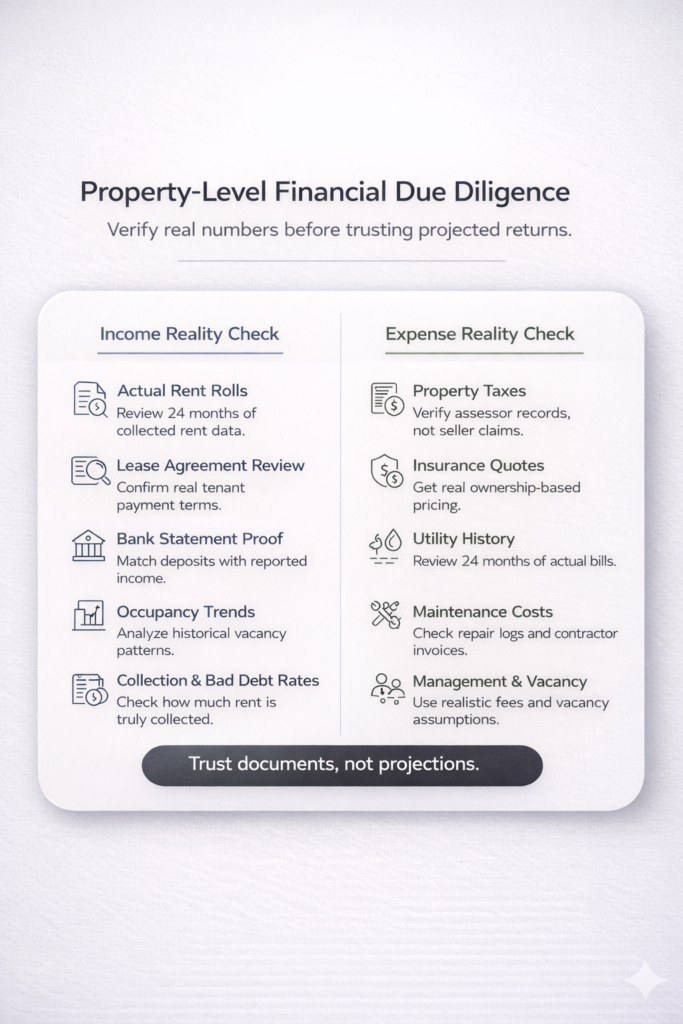
Verify Actual Income, Not Pro Forma Projections
Sellers and syndicators often present pro forma income statements showing ideal scenarios. Your job is to verify actual performance with documentation.
Request and thoroughly review:
- Rent rolls for the past 24 months showing actual collected rents
- Lease agreements for all current tenants
- Bank statements proving deposited rental income
- Historical occupancy rates and trends
- Collection rates and bad debt history
Compare claimed rents against actual market rates. A property advertising “$2,000 monthly rents” might have tenants paying $1,600 with lease agreements proving the lower figure. That $400 monthly difference equals $4,800 annually, significantly impacting investment returns.
Analyze Operating Expenses With Skepticism
Property marketing materials frequently underestimate operating expenses to inflate projected net operating income (NOI). Experienced investors verify every expense category:
Property Taxes: Don’t rely on seller-provided figures. Check county assessor records directly. Property taxes often increase after sale, especially if the property was previously owner-occupied or has outdated assessed values.
Insurance: Get actual quotes from insurers for your ownership scenario. Costs vary dramatically based on owner profile, intended use, and coverage requirements.
Utilities: If the owner pays any utilities, verify 24 months of actual bills. Heating, cooling, water, and sewer costs fluctuate seasonally and can surprise investors who review only summer utility bills.
Maintenance and Repairs: Sellers often project 5-8% of gross income for maintenance. Actual costs for older properties frequently exceed 12-15%. Review maintenance records, contractor invoices, and capital expenditure history.
Property Management: If using professional management, get written fee quotes. Standard rates run 8-12% of collected rents plus leasing fees, not the 6% some pro formas assume.
Vacancy: Markets with claimed 98% occupancy rarely maintain those rates long-term. Use conservative vacancy assumptions (10-15% for most residential properties) regardless of current occupancy.
Calculate Real Returns Using Verified Numbers
Once you’ve verified income and expenses, calculate actual returns using multiple metrics:
Cash-on-Cash Return: Annual cash flow divided by total cash invested. This reveals your actual yearly return on invested capital.
Cap Rate: Net operating income divided by property purchase price. This enables comparison across different properties and markets.
Internal Rate of Return (IRR): This accounts for the time value of money and projected sale proceeds, giving a complete picture of investment performance over your intended holding period.
Properties that show 12% cash-on-cash returns in marketing materials often deliver 6-8% when analyzed with verified numbers and conservative assumptions.
Phase Two: Physical Property Investigation
Financial performance depends entirely on physical condition. A property generating strong cash flow today can become a money pit tomorrow if major systems are failing.
Professional Inspections Are Non-Negotiable
Never skip professional property inspections, regardless of property condition claims. At minimum, obtain:
General Home Inspection: Covers structural integrity, roof condition, HVAC systems, plumbing, electrical, and general property condition. Costs $300-600 and frequently uncovers $5,000-$50,000 in needed repairs.
Specialized Inspections: Depending on property age, location, and type, consider:
- Foundation and structural engineering analysis
- Roof certification
- Electrical system evaluation
- Plumbing scope inspection
- HVAC system analysis
- Pest and termite inspection
- Mold and environmental testing
Cost-to-Cure Estimates: For every identified issue, get contractor quotes for repairs. This creates an accurate budget for required work and negotiation leverage with sellers.
The Walk-Through That Reveals Hidden Issues
Beyond professional inspections, conduct your own detailed walk-through focusing on:
Deferred Maintenance Indicators: Peeling paint, water stains, cracks, sagging gutters, broken fixtures, and dated systems signal neglect. Properties with visible deferred maintenance have expensive hidden issues.
Tenant Treatment: How tenants maintain units reveals property management quality. Well-maintained tenant spaces suggest good screening and management. Trashed units indicate poor tenant selection and management challenges you’ll inherit.
Common Areas: For multi-family properties, common area condition reflects management quality and required capital investment.
Neighborhood Context: Walk the surrounding blocks at different times. Crime, noise, traffic patterns, and neighbor property conditions impact desirability and future value.
Phase Three: Legal and Title Due Diligence
Legal issues can destroy investments even when properties perform financially and physically.
Title Search and Insurance
Comprehensive title searches reveal:
- Current legal ownership
- Liens and encumbrances
- Easements and restrictions
- Boundary disputes
- Unpaid taxes or assessments
Never close without title insurance protecting your ownership interest. Title defects can emerge years later, creating legal nightmares that cost far more than policy premiums.
Zoning and Land Use Verification
Confirm current zoning allows your intended use. Verify:
- Permitted uses under current zoning
- Rental restrictions or caps
- Parking requirements
- Short-term rental regulations
- Pending zoning changes
Properties advertised as “great rental opportunities” may face zoning restrictions limiting rental use or requiring special permits.
Code Compliance and Violation History
Request violation history from the local building department. Unresolved code violations can:
- Block property transfers
- Generate daily fines
- Require expensive corrections
- Create liability for new owners
Review building permits for recent work. Unpermitted renovations create code compliance issues and potential safety hazards.
Environmental Due Diligence
Environmental contamination creates enormous liability. Phase I Environmental Site Assessments identify potential contamination from:
- Previous industrial uses
- Underground storage tanks
- Asbestos and lead paint
- Soil and groundwater contamination
- Wetlands and flood zones
Environmental remediation costs can exceed property values, making contaminated properties uninvestable without significant price adjustments.
Phase Four: Market Analysis and Future Viability
Property-level due diligence is incomplete without understanding market dynamics affecting future performance.
Demographic and Economic Trends
Strong real estate markets share common characteristics:
- Population growth
- Job creation and economic diversification
- Rising household incomes
- Limited new construction relative to demand
Research local economic development plans, major employer expansion or contraction, infrastructure projects, and population trends. Properties in declining markets rarely appreciate regardless of individual property quality.
Comparable Sales and Rental Analysis
Verify valuations using recent comparable sales and rental data. Examine:
- Sales prices for similar properties in the past 6-12 months
- Rental rates for comparable units
- Days on market for sales and rentals
- Absorption rates and inventory levels
Properties priced significantly above comps require extraordinary justification. Claimed rents exceeding market rates won’t materialize when tenants move.
Supply and Demand Dynamics
Future performance depends on supply-demand balance. Investigate:
- Planned residential and commercial development
- Rental vacancy rates and trends
- New construction permits and pipeline
- Absorption of new supply
Markets with significant new supply entering can see rents stagnate or decline even in growing economies.
Phase Five: Management and Operational Due Diligence
Investment performance ultimately depends on effective management and operations.
Evaluate Current Management Quality
If inheriting property management, review:
- Tenant satisfaction and retention rates
- Maintenance response times and quality
- Financial reporting accuracy
- Vendor relationships and contracts
- Regulatory compliance
Poor management destroys property value. Factor management transition costs and potential performance improvement into projections.
Understand Operational Requirements
Different property types require varying management intensity:
- Single-family rentals: Relatively simple management but multiple properties require systems
- Small multi-family (2-4 units): Owner-management possible but time-intensive
- Larger multi-family (5+ units): Professional management typically required
- Commercial properties: Specialized management expertise essential
Ensure you have management capability or access to qualified professionals before investing.
Review Service Contracts and Vendor Relationships
Examine existing:
- Property management agreements and fees
- Maintenance and landscaping contracts
- Utility contracts and service agreements
- Insurance policies
Identify opportunities to reduce costs or improve service quality after acquisition.
Protecting Your Privacy During the Research Process
Thorough due diligence requires extensive information gathering from multiple sources. You’ll research properties across various listing platforms, sign up for market reports and investment newsletters, request information from syndicators, explore financing options from multiple lenders, and register for property alerts in target markets.
This creates a challenge: providing your primary email address to dozens or hundreds of sources fills your inbox with promotional content, exposes you to potential data breaches, and makes it difficult to track which sources provide valuable information versus spam.
Smart investors create a research workflow that protects their primary contact information while enabling comprehensive information gathering. When exploring new investment platforms, researching unfamiliar markets, or requesting materials from unknown syndicators, they use temporary addresses that allow them to evaluate the quality and relevance of communications before committing their primary email.
For example, when researching properties in a new market, you might register with 10-15 different listing services, sign up for market reports from various brokerages, and request information from multiple property management companies. Rather than flooding your primary inbox, you can use addresses at 10minutes.email to receive this initial information flow, evaluate which sources provide valuable insights, and then transition valuable contacts to your primary email while filtering out the noise.
This approach particularly benefits investors conducting preliminary research across multiple markets, evaluating different investment structures (single-family, multi-family, commercial), or exploring various financing options where each path generates significant email correspondence.
Once you’ve identified high-quality information sources, legitimate syndicators, or properties worthy of serious consideration, you can transition those relationships to your primary email while maintaining separation from speculative research activities.
Phase Six: Financial Partner and Syndicator Due Diligence
If investing through syndicators or partnerships, investigate the operators as thoroughly as the properties.
Verify Track Record and Experience
Request and verify:
- Previous investment performance across complete cycles
- Number of projects completed and currently operating
- Investor returns on exited deals (not just current projections)
- Professional experience and qualifications
- References from previous investors
Operators showcasing only successful deals while hiding failures raise red flags. Real estate investing includes both wins and losses; honest operators share both.
Examine Deal Structure and Fees
Understand all fees and how they impact investor returns:
- Acquisition fees
- Asset management fees
- Property management fees
- Refinancing fees
- Disposition fees
- Promote or carried interest structures
Some deals include fee structures that extract 30-40% of cash flow before investors receive distributions, dramatically reducing actual returns.
Assess Communication and Transparency
Quality operators provide:
- Regular financial reporting (monthly or quarterly)
- Transparent communication about challenges
- Clear documentation of all fees and terms
- Accessible investor relations
Operators who avoid questions, provide incomplete information, or pressure investment decisions create risk.
Creating Your Due Diligence Checklist
Successful investors systematize due diligence using comprehensive checklists ensuring nothing gets overlooked. Your checklist should include:
Financial Documentation:
- Rent rolls (24 months)
- Operating statements (36 months)
- Tax returns (3 years)
- Bank statements (12 months)
- Lease agreements (all current tenants)
- Utility bills (24 months)
- Insurance policies and claims history
- Contractor invoices and maintenance records
Legal Documents:
- Title search and insurance
- Survey
- Zoning verification
- Code compliance certification
- Environmental Phase I
- Leases and contracts
- HOA documents (if applicable)
Physical Inspection:
- General inspection report
- Specialized system inspections
- Cost-to-cure estimates
- Capital expenditure projections
- Deferred maintenance analysis
Market Research:
- Comparable sales analysis
- Rental comps
- Economic and demographic data
- Supply pipeline analysis
- Market trend reports
Operational Analysis:
- Management evaluation
- Service contracts review
- Vendor relationship assessment
- Operational improvement opportunities
Red Flags That Should Stop Deals
Certain discoveries during due diligence should halt investments immediately:
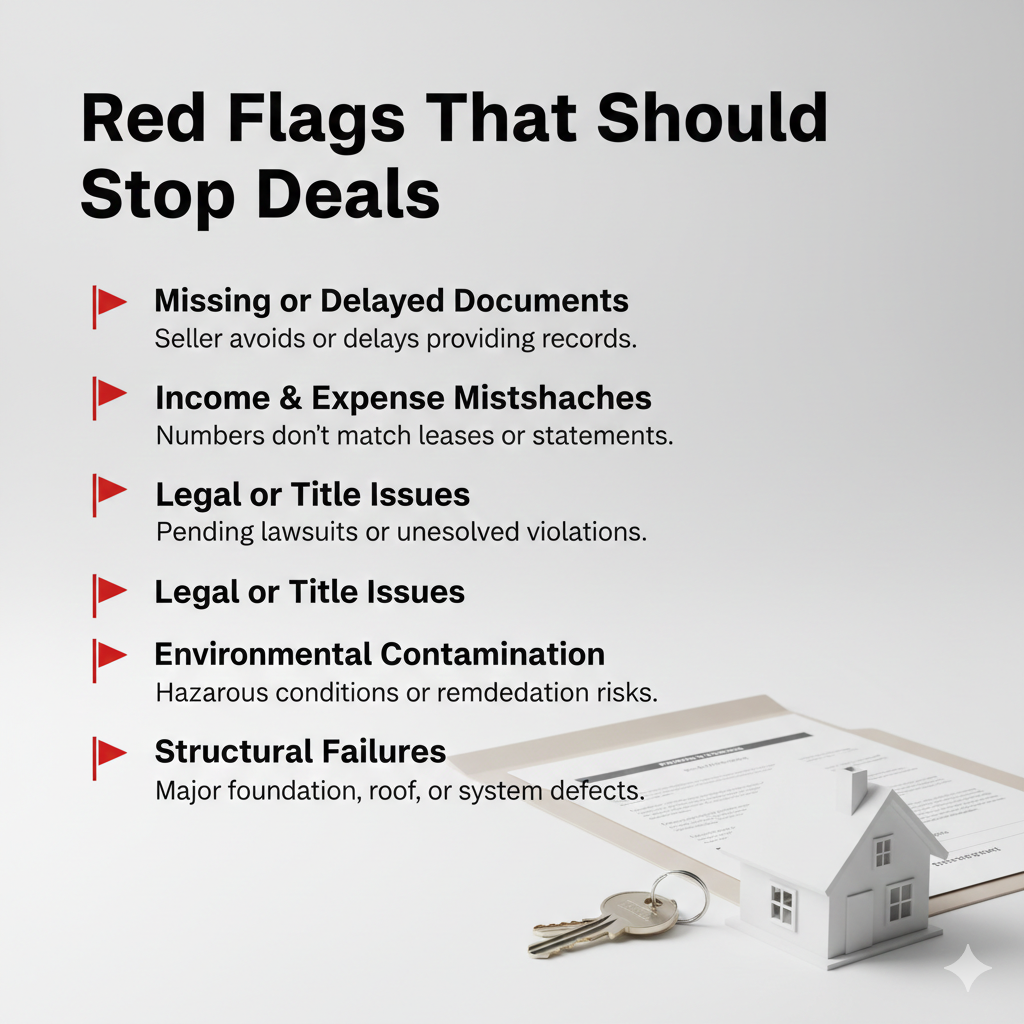
Seller Resistance to Providing Documentation: Legitimate sellers provide requested documentation promptly. Delays, incomplete records, or refusal to share information indicate problems.
Material Discrepancies Between Claims and Documentation: When advertised rents don’t match leases, or projected expenses are 30% below actual costs, the seller is misrepresenting the investment.
Undisclosed Legal Issues: Pending litigation, unresolved code violations, or title defects create enormous risk and liability.
Environmental Contamination: Except for sophisticated investors with remediation expertise, environmental issues typically make properties uninvestable.
Structurally Compromised Properties: Foundation issues, roof failure, or major system defects requiring six-figure repairs often exceed viable renovation budgets.
Declining Markets: Properties in areas experiencing population loss, major employer exits, or economic deterioration rarely appreciate enough to justify investment risk.
Due Diligence for Different Investment Strategies
Different investment approaches require emphasis on specific due diligence areas:
Buy-and-Hold Rental Properties
Focus heavily on:
- Long-term market fundamentals and appreciation potential
- Property condition and deferred maintenance
- Sustainable rents and conservative vacancy assumptions
- Total cost of ownership including all operating expenses
Value-Add Opportunities
Emphasize:
- Renovation scope and cost-to-cure accuracy
- Post-renovation income potential and market demand
- Contractor capabilities and references
- Permitting requirements and timeline
Turnkey Investments
Scrutinize:
- Property management quality and track record
- Actual rental history versus projections
- Lease terms and tenant quality
- Ongoing management and maintenance costs
Syndication and Fund Investments
Prioritize:
- Operator track record and integrity
- Deal structure and fee alignment
- Historical performance across cycles
- Communication and reporting quality
The Cost-Benefit Analysis of Thorough Due Diligence
Comprehensive due diligence costs money: inspections, appraisals, environmental assessments, legal review, and professional consultations can total $5,000-$15,000 or more for larger investments.
But compare those costs against potential losses from undiscovered issues:
- A $30,000 foundation repair
- $50,000 in environmental remediation
- $75,000 in undisclosed deferred maintenance
- Six months of vacancy from overestimated rents
- Legal fees fighting title disputes
Due diligence isn’t an expense. It’s insurance against catastrophic losses and a critical component of generating consistent income and capital growth from real estate investments.
Conclusion: Due Diligence as Competitive Advantage
In competitive real estate markets across the United States, investors who conduct superior due diligence gain decisive advantages. They identify properties other investors overlook, negotiate better terms using discovered leverage, avoid costly mistakes that trap less diligent investors, and confidently invest knowing risks are understood and mitigated.
Real estate investing rewards preparation, research, and systematic analysis. Every hour invested in due diligence protects capital, reduces risk, and increases the probability of achieving projected returns.
The difference between a profitable real estate portfolio and an expensive collection of problem properties often comes down to one factor: the quality and thoroughness of due diligence conducted before investment decisions.
Smart investors recognize that the goal isn’t just acquiring properties. It’s acquiring the right properties at the right prices with full understanding of opportunities and risks. That only happens through comprehensive, systematic, skeptical due diligence that verifies every claim and uncovers every material fact.
Whether you’re making your first investment or adding to an established portfolio, due diligence excellence separates successful investors from cautionary tales.